 Add to Chrome
 Add to Firefox
 Add to Edge
ChartArena: Benchmarking Chart Parsing across Languages, Scenarios, and Formats
May 31, 2026
Charts are a primary medium for conveying quantitative and relational information, yet systematically evaluating chart parsing models remains difficult. Existing benchmarks focus on narrow chart types and leave diagrammatic structures such as flowcharts and mind maps largely unaddressed, while models produce outputs in incompatible formats, and datasets rarely include the printed or hand-drawn images encountered in practice. To address these issues, we introduce ChartArena, a comprehensive bilingual benchmark covering eight chart families spanning both numeric charts and diagrammatic structures, each evaluated across three visual scenarios: digital renderings, printed photos, and hand-drawn photos. The dataset is built via a human-agent collaborative annotation pipeline with multi-stage human verification to ensure annotation reliability. To enable fair cross-model comparison, we further design a format-agnostic evaluation protocol that maps heterogeneous outputs into two canonical semantic spaces, a normalized triple view and a directed graph view, and scores them with structure-aware metrics. Through extensive evaluation of 26 leading MLLMs, we observe three consistent findings: (i) frontier proprietary models such as Gemini 3.1 Pro lead overall, yet the strongest open-source systems are rapidly closing the gap; (ii) document parsing models handle numeric charts reasonably but fall sharply behind on diagrammatic structures; and (iii) expert chart parsers remain limited to narrow chart families. Across all models, radar charts and hand-drawn scenarios stay especially challenging. These findings show that ChartArena exposes clear capability gaps and provides a unified foundation for future progress. ChartArena is publicly available at https://github.com/pspdada/ChartArena.

PhoneWorld: Scaling Phone-Use Agent Environments
May 28, 2026A central bottleneck for phone-use agents is that controllable, reproducible environments covering real mobile behavior are hard to build at scale. Existing mobile-agent benchmarks have made important progress on evaluation, but they do not by themselves provide a scalable way to construct many new phone-use environments. We present PhoneWorld, a reusable pipeline that converts real GUI trajectories and screenshots into controllable phone-use environments, executable tasks, automatic verifiers, and training rollouts. Rather than hand-building one mobile benchmark at a time, PhoneWorld uses real trajectories to recover which screens matter, how screens connect, which interactions must change environment state, and which user goals admit automatic verification. From these signals, it builds runnable mock Android apps backed by read-only app content and mutable state, then derives executable tasks, rule-based verifiers, and training rollouts from the same environments. In its current instantiation, PhoneWorld covers 34 apps across 16 domains, spanning common consumer mobile behaviors such as search, browsing, shopping, booking, media, and social interaction. Under a fixed training budget, replacing 10K steps from an auxiliary AndroidWorld corpus in an AndroidWorld-based baseline with broad PhoneWorld supervision improves all four evaluation benchmarks at once, raising HYMobileBench by 17.7 points, AndroidControl by 6.0 points, AndroidWorld by 14.7 points, and PhoneWorld by 52.5 points. We then study two additional scaling questions: increasing the amount of PhoneWorld supervision strongly improves PhoneWorld performance, and under a fixed PhoneWorld budget, expanding app coverage yields even larger gains. Overall, PhoneWorld shifts the focus from building one mobile benchmark at a time to scaling the supply of phone-use environments themselves.
Chronicles-OCR: A Cross-Temporal Perception Benchmark for the Evolutionary Trajectory of Chinese Characters
May 12, 2026Vision Large Language Models (VLLMs) have achieved remarkable success in modern text-rich visual understanding. However, their perceptual robustness in the face of the continuous morphological evolution of historical writing systems remains largely unexplored. Existing ancient text datasets typically focus on isolated historical periods, failing to capture the systematic visual distribution shifts spanning thousands of years. To bridge this gap and empower Digital Humanities, we introduce Chronicles-OCR, the first comprehensive benchmark specifically designed to evaluate the cross-temporal visual perception capabilities of VLLMs across the complete evolutionary trajectory of Chinese characters, known as the Seven Chinese Scripts. Curated in collaboration with top-tier institutional domain experts, the dataset comprises 2,800 strictly balanced images encompassing highly diverse physical media, ranging from tortoise shells to paper-based calligraphy. To accommodate the drastic morphological and topological variations across different historical stages, we propose a novel Stage-Adaptive Annotation Paradigm. Based on this, Chronicles-OCR formulates four rigorous quantitative tasks: cross-period character spotting, fine-grained archaic character recognition via visual referring, ancient text parsing, and script classification. By isolating visual perception from semantic reasoning, Chronicles-OCR provides an authoritative platform to expose the limitations of current VLLMs, paving the way for robust, evolution-aware historical text perception. Chronicles-OCR is publicly available at https://github.com/VirtualLUOUCAS/Chronicles-OCR.
Uni-OPD: Unifying On-Policy Distillation with a Dual-Perspective Recipe
May 05, 2026On-policy distillation (OPD) has recently emerged as an effective post-training paradigm for consolidating the capabilities of specialized expert models into a single student model. Despite its empirical success, the conditions under which OPD yields reliable improvement remain poorly understood. In this work, we identify two fundamental bottlenecks that limit effective OPD: insufficient exploration of informative states and unreliable teacher supervision for student rollouts. Building on this insight, we propose Uni-OPD, a unified OPD framework that generalizes across Large Language Models (LLMs) and Multimodal Large Language Models (MLLMs), centered on a dual-perspective optimization strategy. Specifically, from the student's perspective, we adopt two data balancing strategies to promote exploration of informative student-generated states during training. From the teacher's perspective, we show that reliable supervision hinges on whether aggregated token-level guidance remains order-consistent with the outcome reward. To this end, we develop an outcome-guided margin calibration mechanism to restore order consistency between correct and incorrect trajectories. We conduct extensive experiments on 5 domains and 16 benchmarks covering diverse settings, including single-teacher and multi-teacher distillation across LLMs and MLLMs, strong-to-weak distillation, and cross-modal distillation. Our results verify the effectiveness and versatility of Uni-OPD and provide practical insights into reliable OPD.
Do Phone-Use Agents Respect Your Privacy?
Apr 02, 2026We study whether phone-use agents respect privacy while completing benign mobile tasks. This question has remained hard to answer because privacy-compliant behavior is not operationalized for phone-use agents, and ordinary apps do not reveal exactly what data agents type into which form entries during execution. To make this question measurable, we introduce MyPhoneBench, a verifiable evaluation framework for privacy behavior in mobile agents. We operationalize privacy-respecting phone use as permissioned access, minimal disclosure, and user-controlled memory through a minimal privacy contract, iMy, and pair it with instrumented mock apps plus rule-based auditing that make unnecessary permission requests, deceptive re-disclosure, and unnecessary form filling observable and reproducible. Across five frontier models on 10 mobile apps and 300 tasks, we find that task success, privacy-compliant task completion, and later-session use of saved preferences are distinct capabilities, and no single model dominates all three. Evaluating success and privacy jointly reshuffles the model ordering relative to either metric alone. The most persistent failure mode across models is simple data minimization: agents still fill optional personal entries that the task does not require. These results show that privacy failures arise from over-helpful execution of benign tasks, and that success-only evaluation overestimates the deployment readiness of current phone-use agents. All code, mock apps, and agent trajectories are publicly available at~ https://github.com/FreedomIntelligence/MyPhoneBench.
MMTIT-Bench: A Multilingual and Multi-Scenario Benchmark with Cognition-Perception-Reasoning Guided Text-Image Machine Translation
Mar 25, 2026End-to-end text-image machine translation (TIMT), which directly translates textual content in images across languages, is crucial for real-world multilingual scene understanding. Despite advances in vision-language large models (VLLMs), robustness across diverse visual scenes and low-resource languages remains underexplored due to limited evaluation resources. We present MMTIT-Bench, a human-verified multilingual and multi-scenario benchmark with 1,400 images spanning fourteen non-English and non-Chinese languages and diverse settings such as documents, scenes, and web images, enabling rigorous assessment of end-to-end TIMT. Beyond benchmarking, we study how reasoning-oriented data design improves translation. Although recent VLLMs have begun to incorporate long Chain-of-Thought (CoT) reasoning, effective thinking paradigms for TIMT are still immature: existing designs either cascade parsing and translation in a sequential manner or focus on language-only reasoning, overlooking the visual cognition central to VLLMs. We propose Cognition-Perception-Reasoning for Translation (CPR-Trans), a data paradigm that integrates scene cognition, text perception, and translation reasoning within a unified reasoning process. Using a VLLM-driven data generation pipeline, CPR-Trans provides structured, interpretable supervision that aligns perception with reasoning. Experiments on 3B and 7B models show consistent gains in accuracy and interpretability. We will release MMTIT-Bench to promote the multilingual and multi-scenario TIMT research upon acceptance.
Towards Real-World Document Parsing via Realistic Scene Synthesis and Document-Aware Training
Mar 25, 2026Document parsing has recently advanced with multimodal large language models (MLLMs) that directly map document images to structured outputs. Traditional cascaded pipelines depend on precise layout analysis and often fail under casually captured or non-standard conditions. Although end-to-end approaches mitigate this dependency, they still exhibit repetitive, hallucinated, and structurally inconsistent predictions - primarily due to the scarcity of large-scale, high-quality full-page (document-level) end-to-end parsing data and the lack of structure-aware training strategies. To address these challenges, we propose a data-training co-design framework for robust end-to-end document parsing. A Realistic Scene Synthesis strategy constructs large-scale, structurally diverse full-page end-to-end supervision by composing layout templates with rich document elements, while a Document-Aware Training Recipe introduces progressive learning and structure-token optimization to enhance structural fidelity and decoding stability. We further build Wild-OmniDocBench, a benchmark derived from real-world captured documents for robustness evaluation. Integrated into a 1B-parameter MLLM, our method achieves superior accuracy and robustness across both scanned/digital and real-world captured scenarios. All models, data synthesis pipelines, and benchmarks will be publicly released to advance future research in document understanding.
Prune Redundancy, Preserve Essence: Vision Token Compression in VLMs via Synergistic Importance-Diversity
Mar 11, 2026Vision-language models (VLMs) face significant computational inefficiencies caused by excessive generation of visual tokens. While prior work shows that a large fraction of visual tokens are redundant, existing compression methods struggle to balance importance preservation and information diversity. To address this, we propose PruneSID, a training-free Synergistic Importance-Diversity approach featuring a two-stage pipeline: (1) Principal Semantic Components Analysis (PSCA) for clustering tokens into semantically coherent groups, ensuring comprehensive concept coverage, and (2) Intra-group Non-Maximum Suppression (NMS) for pruning redundant tokens while preserving key representative tokens within each group. Additionally, PruneSID incorporates an information-aware dynamic compression ratio mechanism that optimizes token compression rates based on image complexity, enabling more effective average information preservation across diverse scenes. Extensive experiments demonstrate state-of-the-art performance, achieving 96.3% accuracy on LLaVA-1.5 with only 11.1% token retention, and 92.8% accuracy at extreme compression rates (5.6%) on LLaVA-NeXT, outperforming prior methods by 2.5% with 7.8 $\times$ faster prefilling speed compared to the original model. Our framework generalizes across diverse VLMs and both image and video modalities, showcasing strong cross-modal versatility. Code is available at https://github.com/ZhengyaoFang/PruneSID.
Omni-DPO: A Dual-Perspective Paradigm for Dynamic Preference Learning of LLMs
Jun 11, 2025Direct Preference Optimization (DPO) has become a cornerstone of reinforcement learning from human feedback (RLHF) due to its simplicity and efficiency. However, existing DPO-based approaches typically treat all preference pairs uniformly, ignoring critical variations in their inherent quality and learning utility, leading to suboptimal data utilization and performance. To address this challenge, we propose Omni-DPO, a dual-perspective optimization framework that jointly accounts for (1) the inherent quality of each preference pair and (2) the model's evolving performance on those pairs. By adaptively weighting samples according to both data quality and the model's learning dynamics during training, Omni-DPO enables more effective training data utilization and achieves better performance. Experimental results on various models and benchmarks demonstrate the superiority and generalization capabilities of Omni-DPO. On textual understanding tasks, Gemma-2-9b-it finetuned with Omni-DPO beats the leading LLM, Claude 3 Opus, by a significant margin of 6.7 points on the Arena-Hard benchmark. On mathematical reasoning tasks, Omni-DPO consistently outperforms the baseline methods across all benchmarks, providing strong empirical evidence for the effectiveness and robustness of our approach. Code and models will be available at https://github.com/pspdada/Omni-DPO.
Recognition-Synergistic Scene Text Editing
Mar 11, 2025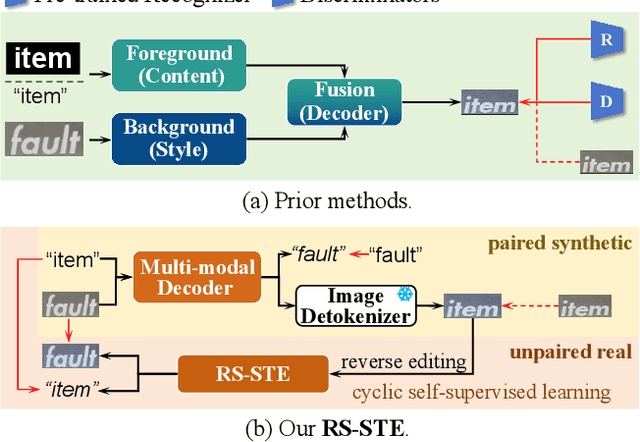
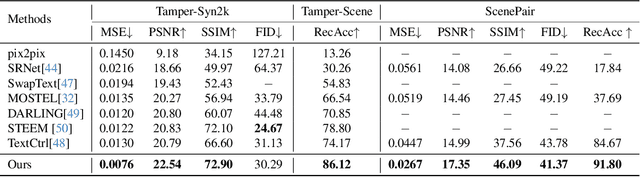
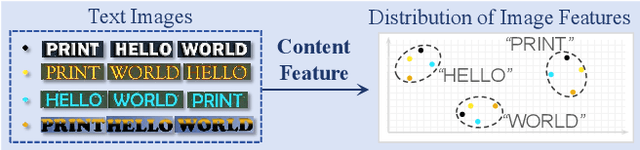
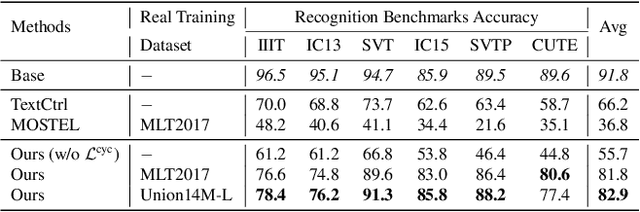
Scene text editing aims to modify text content within scene images while maintaining style consistency. Traditional methods achieve this by explicitly disentangling style and content from the source image and then fusing the style with the target content, while ensuring content consistency using a pre-trained recognition model. Despite notable progress, these methods suffer from complex pipelines, leading to suboptimal performance in complex scenarios. In this work, we introduce Recognition-Synergistic Scene Text Editing (RS-STE), a novel approach that fully exploits the intrinsic synergy of text recognition for editing. Our model seamlessly integrates text recognition with text editing within a unified framework, and leverages the recognition model's ability to implicitly disentangle style and content while ensuring content consistency. Specifically, our approach employs a multi-modal parallel decoder based on transformer architecture, which predicts both text content and stylized images in parallel. Additionally, our cyclic self-supervised fine-tuning strategy enables effective training on unpaired real-world data without ground truth, enhancing style and content consistency through a twice-cyclic generation process. Built on a relatively simple architecture, \mymodel achieves state-of-the-art performance on both synthetic and real-world benchmarks, and further demonstrates the effectiveness of leveraging the generated hard cases to boost the performance of downstream recognition tasks. Code is available at https://github.com/ZhengyaoFang/RS-STE.